
Thunder and Rain for Studying
Steady rain with the thunder kept far enough back that it does not pull you out of a sentence.
- Rain 58%
- Thunder 30%
Brown noise is the best study sound to try first for reading, writing and problem sets, because it has no words or tune in it and it softens traffic and a humming fridge. Pink noise is the lighter option for a long session. Steady rain suits you if a flat hiss or rumble gets on your nerves. For memorizing and for hard reading, silence may still beat any sound you put on.
Slo plays these sounds free in your browser at slonoise.com, and as an app on iPhone, Android and Mac. Start with brown noise for studying, or the thunder and rain study mix when housemates or a loud library still cut through.

| Study task | First choice | Alternative | Avoid first |
|---|---|---|---|
| Dense reading | Lyrics and recognizable speech | ||
| Essay writing | New or dramatic music | ||
| Math and problem sets | Changing playlists | ||
| Flashcards | Silence | Songs with words | |
| Creative outlining | Busy café conversation | ||
| Routine note cleanup | High-energy music | ||
| Noisy library or dorm | or | Raising volume to overpower the room |
Treat the table as a set of starting points. A good study sound makes the room around you less noticeable, and then you stop thinking about the sound too. If you keep noticing it, switch to something plainer.
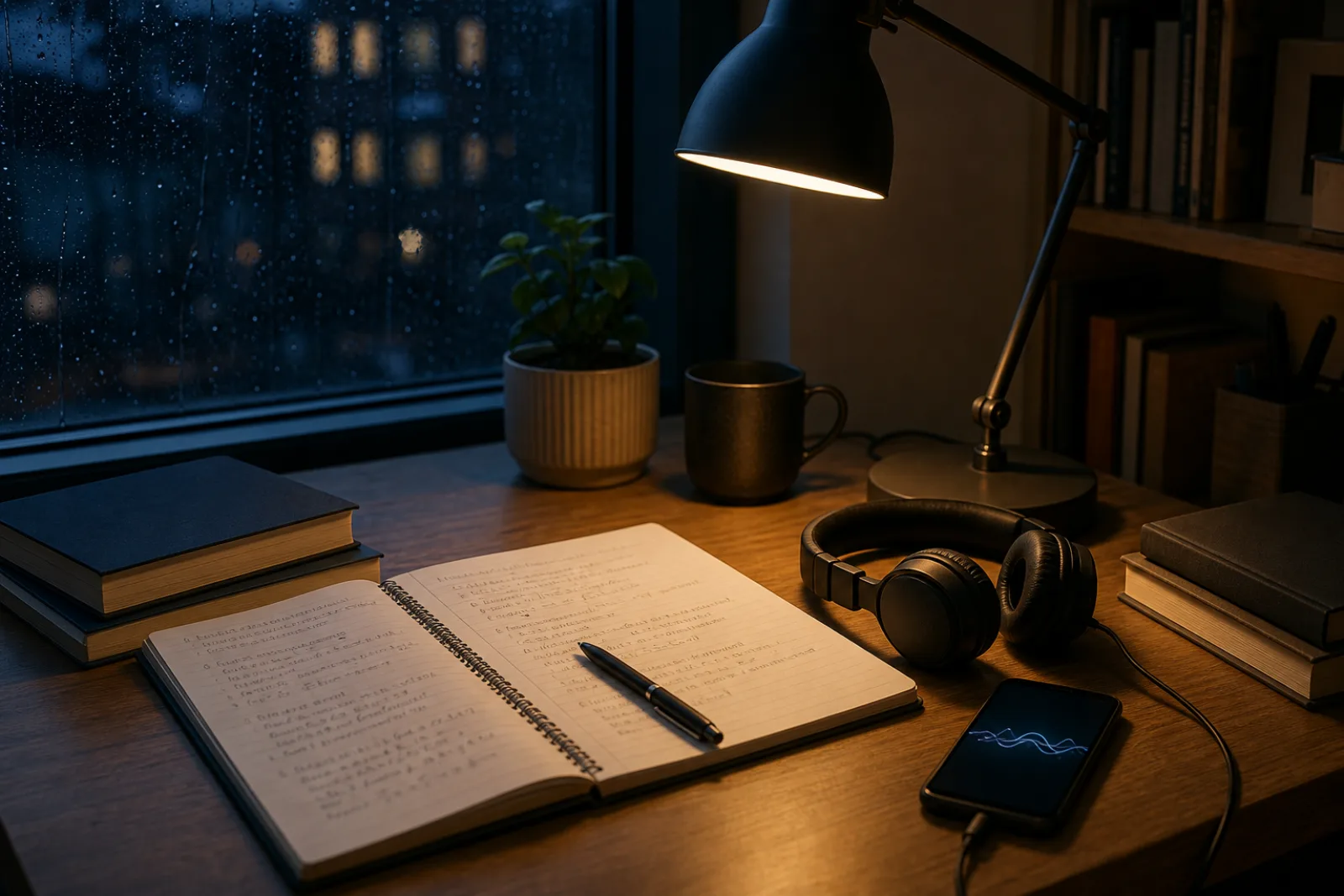
Background sound can cover what distracts you, and it can also pull at your attention itself. Which one you get depends on the work you’re doing, the sound you picked and the room you’re in.
Words are the clearest risk when the work is reading or writing. Speech you can make out fights with reading and remembering, because both use the language part of your brain. In a 2023 experiment, people remembered less and understood less of what they read when the music had lyrics in it. Music with no singing did less harm, though it didn’t make anyone better either.
What people say online about noise colors runs well ahead of the research. A 2024 review of the studies found that white or pink noise helped young people with ADHD or strong attention problems a little on tasks, on average. The same review found a small setback for young people without those problems, and it turned up no studies of brown noise at all. So nothing here makes brown noise an ADHD treatment, and a playlist you enjoy is not a diagnosis. If that is your question, an assessment by a doctor is the answer.
A wider review of steady, moderate noise found mixed results, with big differences between one task and the next and between one person and the next. Your own test against silence tells you more than any sound sold as the one study frequency.
Brown noise sounds like a deep rumble, and there’s barely any hiss in it. There are no words, no beat and nothing that suddenly changes, so your ear has nothing to follow.
Best for: technical reading, essay drafting, coding and long problem sets, in a room with traffic outside or a boiler nearby.
Why it may help: it covers traffic, a boiler and bass through the wall without putting words in your ears. Hardly anyone has tested brown noise and studying directly, so it’s first here because it covers that kind of noise and is easy to sit with for an hour, not because it’s proven to make you work better.
When to switch: if the bass feels heavy, or your speaker makes the rumble sound lumpy, try pink noise.
If you mostly read rather than write, best sounds for reading covers novels, textbooks and long articles in more detail.
Pink noise has less hiss than white noise, so it sounds softer. It still covers the general hum of a room, without the sharp edge white noise has.
Best for: reading, math and going over the same material again, when brown noise feels too heavy.
Evidence limit: researchers have tested pink noise on attention tasks and in sleep labs, but that doesn’t mean steady pink noise helps every student. Put it on for one work block and see how the work goes.
Rain is mostly hiss, with small changes in it that keep it from sounding flat. A gentle recording softens a hallway, a keyboard or a street a few doors away.
Best for: planning an essay, working through diagrams and charts, and rooms where a flat hiss or rumble gets annoying.
When to switch: single drips and claps of thunder break into careful work. Pick a steadier rain, or turn the thunder down.
White noise is a bright, even hiss, close to radio static. It blurs voices, keyboard clicks and other sharp sounds better than brown noise does, and it sounds louder than brown noise at the same setting.
Best for: a short block of work near someone talking, a loud keyboard or another sharp sound.
When to switch: the hiss tires some people out after a while, and pink noise is the softer version of the same thing. Turning it up until the talking is gone won’t work either. No sound takes voices away, because your brain keeps listening for words. A sound can only blur them. Headphones that fit well, or a quieter room, do more for you than volume does.
A river or a quiet stretch of woodland has movement in it and no words. Researchers who pooled the studies in 2021 found that natural sound left people less stressed and less annoyed, on average. That’s a rest for your head, which is a different thing from concentration.
Best for: outlining, drawing diagrams, design work, or a break between two hard study blocks.
When to switch: birds, insects, waves and gusts of wind all arrive suddenly. While you’re reading they can pull at you more than a plain hiss or rumble would. See the benefits and limits of nature sounds.
Lo-fi has a beat and a tune, even with nobody singing. In a 2021 study, students who played music they liked drifted off less during an easy attention task, but they weren’t any quicker at it than students working in silence. Music takes up some of your attention wherever you put it.
Best for: tidying up notes, formatting references, drawing, or going back over material you already know.
When to switch: for something new, for lines you have to learn word for word, or for dense reading, go to silence or a plain noise. If you find yourself waiting for the next beat or the next song, you’re listening to music and not studying.
Try to shut the noise out before you turn anything up. Close the door, move away from the conversation, or put on headphones that fit well. Brown noise or rain then softens whatever is left. Keep it quiet enough to hear your alarms and anyone who needs you.
Start with silence. If whispers, chairs or keyboards keep breaking your concentration, try pink or brown noise at a quiet setting. A library is quiet already, so anything you add can end up being one more thing to notice.
Talk you can make out is hard to ignore while you read or write. Play a steady noise at a level you can still think over, or take a table away from the talking. Café sound suits loose, early thinking, but it’s a poor default when you need to follow an argument.
Sound can’t undo lost sleep. A calm track can make the room nicer to sit in at one in the morning, but you still need the sleep, the breaks and the food.
Pick one task you do often and a fixed block of time. Play a sound in one session and work in silence in the other. Keep the place, the difficulty and your notification settings as close to the same as you can.
Write down three things after each block: how many pages or questions you got through, how many careless mistakes you made, and how often the room or the sound pulled you away. Keep the sound only if the work went better and you didn’t end up more tired.
Play it as quietly as you can get away with. The World Health Organization advises keeping personal-audio listening below an average of 80 dB, and listening for less time as the level goes up. Study sound should sit well under anything that feels forceful. Stop if you notice ringing, muffled hearing or any discomfort.
Study presets
Keep the storm quiet if you like the weather, or switch to river and green noise once the thunder starts pulling you out of the work. You can set each sound's volume in the browser.
Steady rain with the thunder kept far enough back that it does not pull you out of a sentence.

Running water with a steady hiss underneath, for a desk where the room keeps interrupting you.
Brown noise is the best sound to start with for reading, writing and problem sets, because it is steady and has no words in it. Pink noise is lighter, and gentle rain gives you something less flat to sit with. Try each one against silence on the same kind of task.
Brown noise is the one to start with for reading and writing: it is a rumble with almost no hiss, so it covers traffic and a fridge without adding words. Pick pink noise if brown feels heavy, or if you are working through math and problem sets. Save white noise for sharp sounds that need covering, such as voices or a clattering keyboard.
It covers a rumbling room without putting words or a tune in your ears, which is why a lot of students like it. Hardly anyone has studied brown noise and studying directly, so it is not a proven concentration tool and it is not a treatment for ADHD.
Brown noise is the better default for reading and writing, because the deep rumble covers traffic and machinery and most people can sit with it for an hour. White noise is the brighter hiss, and it blurs voices and keyboard clicks better, so choose it when the thing bothering you is somebody talking. Neither one takes voices away completely.
Silence is the safer bet when you are memorizing, reading something hard, or writing. Music with no singing can be fine for routine work, but lyrics get in the way of remembering and understanding. Liking a track does not mean you work better with it on.
A 2024 review of the research found that white or pink noise helped young people with ADHD or strong attention problems a little on tasks, on average, and set back young people without those problems a little. It found no studies of brown noise at all. None of this replaces an assessment by a doctor. Our brown noise for ADHD guide has the numbers.
Use the quietest level that makes the room noise less obvious. You should still hear alarms and anyone talking to you. Turn it down or off if it feels tiring, or if you notice ringing, muffled hearing or any discomfort.
Each of these opens with the volumes and the timer already set for one study block. Press play and get started.
Keep this mix on your phone
Stack it under rain, keep the blend, and play it with the screen off. Slo, on iOS, Android and Mac.