White noise for dogs: is it good for them, and how loud to play it
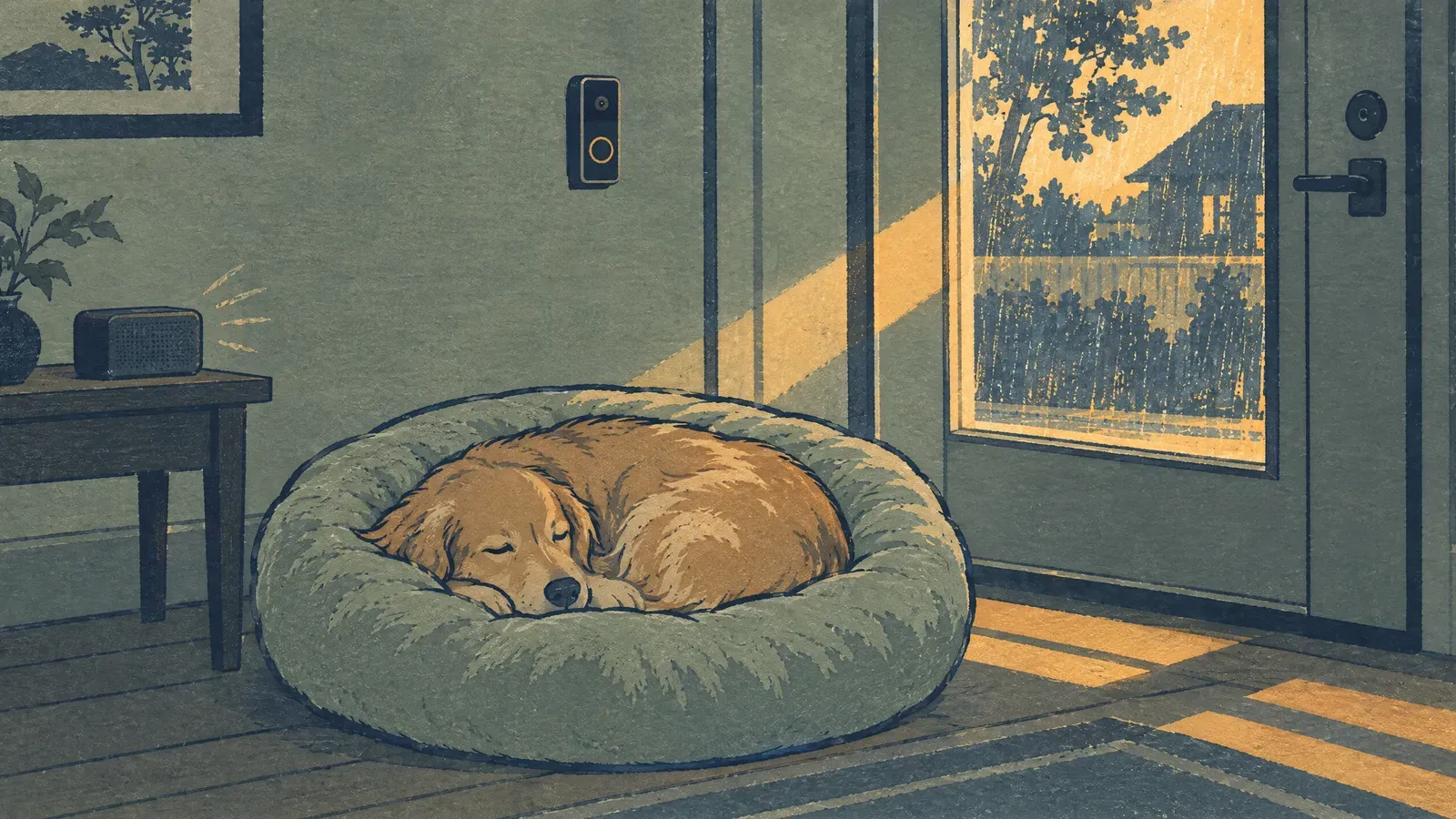
White noise doesn’t calm a dog down. What it does is blur the sounds your dog reacts to, like the neighbor’s door or a truck pulling away outside, so fewer of them arrive as a separate event worth barking at. Many owners find that helps with everyday noise, and at a low volume there’s nothing known to go wrong with it. Slo plays white, brown and pink noise free in a browser tab with a timer, so you can try it tonight in the room your dog sleeps in. Two things to carry with you: dogs hear higher pitches than we do, so set it quieter than feels right, and a dog that panics when you leave the house needs a vet rather than a louder speaker.
Is white noise bad for dogs?
Nobody has tested steady sound on dogs the way it’s been tested on sleeping adults, so there’s no study to point at in either direction. What is clear is that the risk lives in the volume and the distance. Hearing damage comes from loud sound close to the ear over long hours, for a dog as much as for you, and quiet noise from a speaker across the room is nowhere near that.
That leaves you with two dials that matter. Keep the level low enough that you can talk over it, put the speaker away from where your dog lies down, and leave the door open so your dog can walk out of the room. If your dog keeps leaving, turn it off instead of turning it up.
Can dogs hear white noise?
Yes, and they hear more of it than you do. Dogs pick up pitches that are silent to us; Louisiana State University’s vet school puts the top of a dog’s range at about twice the top of ours. White noise is an even hiss spread across all of those pitches, so your dog hears a good part of it that you can’t hear at all.
That’s the practical reason to keep it quiet. You set the volume standing up, a few feet from the speaker, hearing only part of the sound. Your dog is on the floor, further away, hearing all of it. Brown noise is the deep-rumble version of the same idea, with far less of that high hiss in it, and it’s where some owners end up if white noise seems to bother their dog.
What color noise is best for dogs?
There’s no color dogs prefer. A steady sound only hides noises at a similar pitch to itself, so what you pick follows the noise you’re trying to cover.
| Try | When the trigger is | What it sounds like |
|---|---|---|
| Brown noise | Traffic, a truck, thunder in the distance, bass through a wall | A deep rumble, like wind heard from indoors |
| White noise | The doorbell, keys, footsteps on the stairs, voices in the hallway | An even hiss, like a shower running in another room |
| Pink noise | Some of both, or you can’t tell which | A softer hiss with more depth underneath it |
Noise from outside arrives with its sharper, higher parts already taken out by the wall, and what gets through is the deep part. That’s why brown noise is the usual first try for a street or for weather. Indoors the triggers are short and sharp, and white noise covers more of them.
Your ears will settle this quicker than a table. Play these at the same level, a few seconds each.
One catch on brown noise: a phone speaker can’t produce deep sound, so brown noise from a phone on the counter is mostly the quiet parts of brown noise. Use a small speaker if that’s the direction you go. The guide to the noise colors covers the rest of them.
How loud, and where to put the speaker
Start quieter than you think you need. Raise it until the trigger stops standing out, then leave the dial alone. Two checks: you can speak in the room without lifting your voice, and you can still hear the doorbell yourself.
Placement does more work than volume here. Put the speaker between your dog and the wall or window the noise comes through, on the far side of the room from the bed or the crate. You’re trying to lift the background along the path the noise takes, and a speaker parked by your dog’s head is only a loud thing by your dog’s head.
Timing is the part people get backwards. Start it an hour before you leave, the afternoon before a storm is forecast, or when the puppy goes in for the evening and before any crying starts. Sound that switches on at the same moment as something frightening becomes part of the frightening thing. Sound that’s been on since dinner is just part of the room by then, and the dog has stopped noticing it. Then set the timer for the stretch you actually need: an hour covers the first hour alone, and there’s an all-night setting if the noise outside runs until morning.
When owners reach for it
Home alone
An empty apartment is quiet, which means every sound from the street lands against silence. A steady sound in the room makes the street less stark, and plenty of owners leave it running for the first hour after they go. It isn’t a treatment for separation anxiety, though, and a dog that can’t cope alone, drooling and barking for hours or chewing the door frame, needs help from a vet. A speaker left on to cover the sound of it isn’t that help. If a flat hiss gets on your nerves, rain over brown noise gives you the same cover with more to listen to.
Barking at noise in the hallway
Deliveries, the elevator, the neighbor’s door. Put white noise in the hallway itself, quietly, instead of in the living room, and fewer of those sounds arrive as distinct events. Many owners find that’s enough to cut the barking down. It doesn’t change what a knock at the door means to your dog.
A puppy’s first nights
A house you’ve long stopped hearing is full of noise to a puppy: the fridge, the boiler, a car door at midnight. A low steady background flattens the differences between them, so no single one of them stands out. Start it the first night, keep it the same every night after, and change one thing at a time if it isn’t working.
Thunderstorms
Thunder at a distance is a deep rumble, and brown noise takes some of the edge off it. A strike close by is far louder than any speaker in a house, and the thud comes up through the floor as well as through the air, so expect the storm to win those minutes. Fireworks need their own evening plan, and what to do when a dog is scared of fireworks walks through it.
When it’s a vet’s job, not a speaker’s
Background sound is a comfort measure, and comfort measures have the least behind them of anything in the toolkit. The biggest owner survey on firework fear found the things that genuinely helped were training built up over weeks and, for some dogs, medication from a vet; the fireworks guide has that in full.
So be honest about which problem you have. If your dog panics, drools, hides or destroys things when the noise starts or when you go out, that’s noise phobia or separation distress, and the American Veterinary Society of Animal Behavior says cases like those often need a veterinary behaviorist or a certified applied animal behaviorist involved. Make the call this week. Keep the noise on in the meantime if it seems to help, and don’t let it stand in for the appointment.
Questions people ask
Is white noise bad for dogs?
Nobody has studied it in dogs, so judge it by the two things you control: volume and distance. Keep it quiet enough to talk over, keep the speaker away from where your dog lies down, and leave the door open so your dog can walk out. A dog that keeps leaving the room is answering the question for you.
Can dogs hear white noise?
Yes, and further up the scale than you can. A dog’s hearing reaches roughly twice as high in pitch as a person’s, and an even hiss like white noise has plenty going on up there. So it’s louder to your dog than it is to you. Set it quieter than feels right.
What color noise is best for dogs?
Pick by the sound you want covered. Brown noise, a deep rumble, for outdoor noise like traffic and distant thunder. White noise, an even hiss, for sharp indoor noise like the doorbell, keys or voices in the hallway. Pink noise sits between them when it’s some of both.
Is white noise good for puppies?
Many owners run something steady through a puppy’s first nights, when the fridge and the boiler are still strange sounds. Keep it quiet, keep it the same every night, and put the speaker across the room from the crate instead of right beside it.
Do I need a white noise machine for a dog?
No. A machine is a speaker with a dial on it. The same noise plays free in a browser tab, and you get a timer and a real volume slider with it.
Will it stop my dog barking at the doorbell?
It can make the doorbell less obvious, and many owners find that means fewer barks. It doesn’t change what the doorbell means to your dog, so if the barking itself is the problem, that’s training work.
Sources
- Riemer, S. (2020). Effectiveness of treatments for firework fears in dogs, Journal of Veterinary Behavior 37, 61–70. Owner survey on what helped and what didn’t.
- American Veterinary Society of Animal Behavior, A dog’s least favorite holiday, on noise phobia and when a veterinary behaviorist should take over.
- Louisiana State University School of Veterinary Medicine, hearing ranges by species.
Read next
- The colors of noise covers what each color sounds like and where people use it.
- White noise for cats does the same for a cat that startles at the door.
Explore more sounds in Slo
Stack two or three sounds, keep the blend, and let the timer stop it. Slo, on iOS, Android and Mac.