White Noise for Babies: Is It Safe, and How Loud?
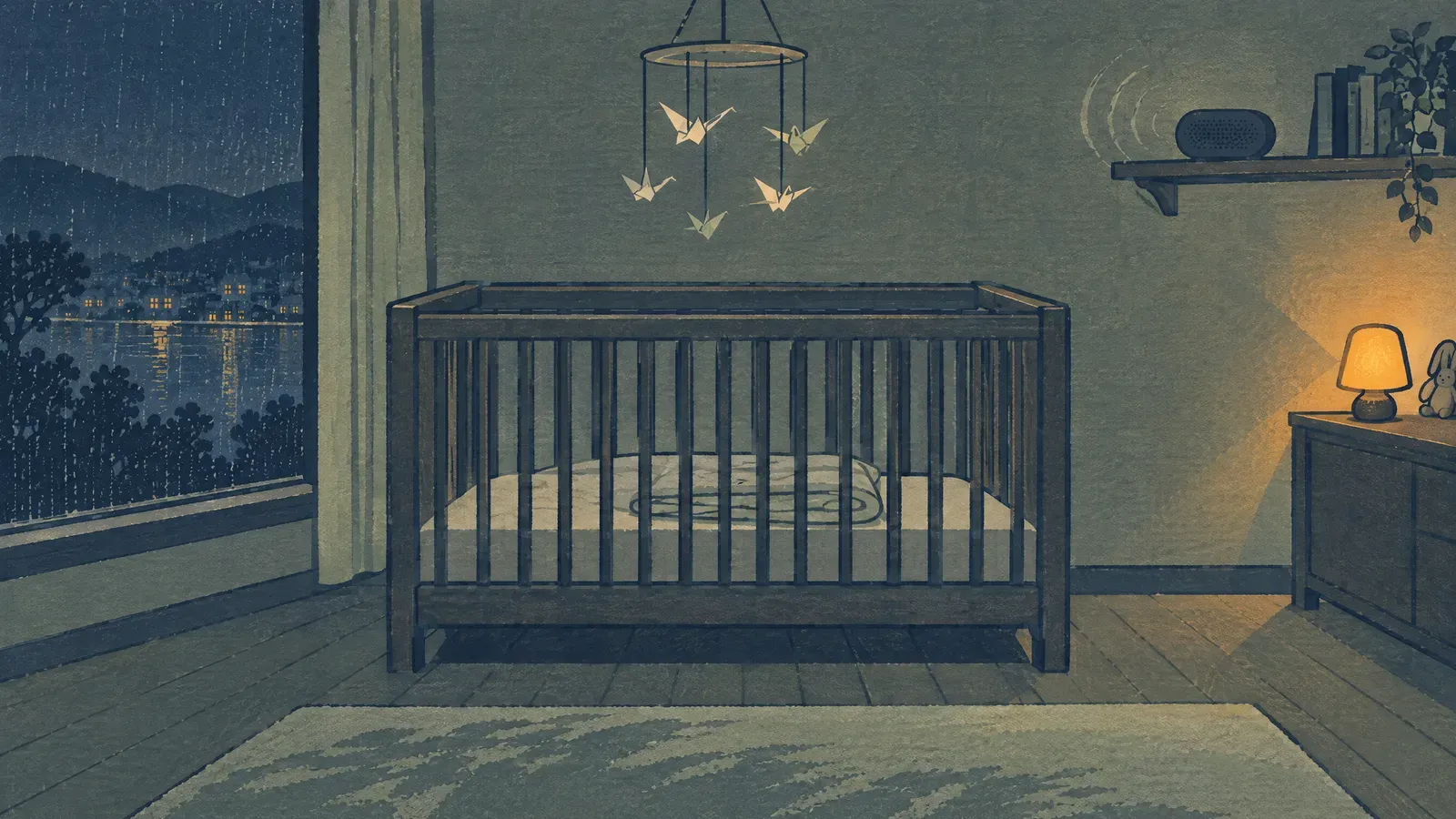
Most parents can use white noise in a nursery if they follow two rules from the researchers who tested these machines: keep it quiet, and keep it far from the crib. Put the phone or speaker well across the room, never in the crib or on the rail, and set the level standing next to the crib until someone talking in the doorway is still easy to hear over it. In 2014, researchers measured 14 infant sleep machines at full volume and found every one louder at 30 cm, about the distance of a crib rail, than hospital nurseries allow. Their advice to parents was the lowest volume, the shortest time, and as far from the baby as the room allows. Slo plays white noise free in a browser tab with a timer you set, and the nursery preset opens quiet. Anything you’re worried about with your own child belongs with your pediatrician.
Is white noise safe for a baby?
The risk researchers found is volume: a machine that’s too loud, too close, for too long. Kept quiet and away from the crib, that risk is the one you control, and the measurements are below. Whether white noise suits your own child is a question for your pediatrician.
Sarah Hugh and colleagues in Toronto bought 14 infant sleep machines, played each one at full volume, and read the level at 30, 100 and 200 cm from the speaker. Thirty centimeters is about a crib rail. Two hundred is about across the room. At 30 cm, all 14 were above 50 A-weighted decibels, the limit recommended for babies in hospital nurseries, and three were above 85, loud enough to breach an adult workplace limit over an eight-hour shift.
What the authors told parents follows straight from that: keep the machine as far from the baby as you can, never in the crib or on the rail, at the lowest volume, for the shortest time. Sound drops off fast as it travels, so carrying the speaker across the room changes more than anything you can do with the volume slider. The AAP made the same three points in its 2023 statement on noise and children: distance, low volume, limited use.
So the setup is the safety measure, and it’s the part you control. Get the speaker across the room and the level low, and you’ve done what the research actually asks for. The rest, including whether it suits your child at all, is a conversation with your pediatrician.
How loud, and where do you put it?
Do it in this order, because the order is what goes wrong. Move the device across the room first, at crib height or above and pointing away. Then press play. Then walk over and set the level standing beside the crib. Do it the other way around and you end up with a loud speaker turned down a little.
The slider can’t tell you what arrives. It’s a scale on the sound going out, and three things it can’t see decide what reaches the crib: how high the device’s own volume sits, how loud its speaker is, and how far away it stands. Forty percent on a phone on a dresser and forty percent on a Bluetooth speaker on the floor are two different rooms.
So set it by ear, from the right place. Turn it down until it’s quieter than feels right when you’re standing at the door. The check that needs no equipment: someone speaking normally in the doorway should still be easy to hear over it. If you’d rather have a number than an impression, a sound meter app held at crib height gives you a rough one, and it’s worth doing once.
Our nursery preset opens at 40% with the timer set until morning, and says the same thing about distance on the page. Forty percent is a place to begin. No slider position is safe on its own, because what reaches your baby depends on the device and the distance, which is why the walk over to the crib does more than the screen does.
The setup to avoid is the common one: a phone propped against the crib bars, because that’s where you were standing when you started the sound, and at three in the morning it’s the easy thing to do. It puts a small, bright speaker within arm’s reach of an ear that can’t move away from it. Carrying it to a shelf across the room takes ten seconds.
All night, or a timer?
Both are common, and the timer is the control most people never touch.
A short timer of 30 or 60 minutes covers the settling and then leaves the room quiet, which is closer to the shortest-time advice in that 2014 study. An all-night timer keeps the background steady, so a garbage truck at five in the morning arrives against something instead of into silence. The trade is plain: all night means eight hours of sound, and the authors asked for the shortest stretch you can manage.
We ship the all-night preset because that’s what parents look for. It’s also the version where the distance and the level stop being fine detail, so if you run it that way, spend the ten seconds on where the speaker sits. Which suits your child is a question for you and your pediatrician, not something a preset decides.
Will my baby become dependent on it?
A room with sound in it every night becomes the normal room, and a quiet one can feel strange for a few nights after that. This is a habit and not a harm, and nothing goes wrong if it happens. It does loosen more easily early than late, so if you’d rather not have the unwinding to do in a year, keep the level low and let some naps happen without it.
White, pink or brown in a nursery?
They’re the same kind of sound spread differently, and none of them is the correct one. Listening decides this quicker than reading does. Try each one for a few seconds, at the low level you’d actually run in the nursery.
White noise is a bright, even hiss, with plenty of treble in it. Pink noise is softer and rounder, closer to steady rain. Brown noise is a deep rumble with most of its weight at the bottom. Pick whichever you can run at a lower level and still stop noticing, because the level and the distance matter far more than the color.
Two things are worth knowing about brown noise in a nursery. A phone speaker can’t really play a deep rumble, so brown noise from a phone gives you mostly the part of brown noise that’s missing. And a deep rumble travels through walls more easily than a hiss does, so brown noise in the nursery is more audible in the next room than white noise at the same setting.
If a flat hiss bothers you, rain layered under soft pink noise gives the same steady background with some texture in it. The colors of noise page goes further into how they differ.
What it won’t do
It won’t soundproof the room. A steady sound raises the background so that sudden noises stand out less against it, which is a different thing from stopping them arriving. Where you can quiet the source instead, the World Health Organization’s noise advice puts that first: a closed door does more than a louder speaker.
The research is also thinner than the shelf of products suggests. The 2021 review that gathered up this research found mixed results on very low quality evidence, so nobody can honestly tell you what a track will do for one child.
And it won’t make a baby sleep. A baby who is hungry, unwell, too warm or working through something new isn’t a volume problem, and turning the sound up until it covers crying competes with the one sound you need to hear. If sleep is a worry that’s lasting, that belongs with your pediatrician. This page carries no age for starting and no recommendation about your child, because nobody can give either one at a distance.
When to stop
There’s no medical age to aim for. The 2014 study measured sound pressure from infant sleep machines; it never tested when to retire one. The AAP’s 2023 noise statement asks for distance, low volume and limited use, and gives no age to stop. Treat any exact age you read elsewhere as a guess.
In practice, a toddler is ready to try without it when a nap without the sound goes about the same as a nap with it. Weaning goes better as a fade than a cutoff. Reverse the level and the timer over a week or two: lower the level a notch every few nights until it’s barely there, then switch an all-night timer to one that ends twenty or thirty minutes after your toddler is usually asleep, so the room goes quiet once the hard part is done. Then stop playing it. If a night goes badly, hold that step for a few more nights instead of starting over.
Leave the rest of the routine untouched: same bedtime, same book, same room. The sound was one layer in it, and one layer comes out more cleanly when nothing else changes at the same time.
Two things are specific to this age. Many daycare rooms don’t run a sound machine, so it’s worth testing a nap without one before your toddler needs it to work away from home. Travel cuts the other way: bring the same device and the same setting, because an unfamiliar hotel room without the familiar sound can make that night harder. And if your toddler asks for the noise by name, that’s usually a request for the routine around it. A song or a few minutes of talking often covers the same ground.
If you keep it running past this point, the distance and volume above still apply. A toddler bed sits differently in a room than a crib did, so check where the speaker stands instead of assuming last year’s spot is still right.
Nothing to install
The player runs in a browser tab. Open the page, pick a sound, set a timer, set a level. No download, no account, no machine to buy, and no app holding the screen awake on the phone you also use as a monitor. The Slo mixer works the same way if you want two layers instead of one, and there are downloads for iPhone, Android and Mac when you’d rather not keep a tab open.
Common questions
Is white noise safe for a baby?
It depends on where you put it and how loud you set it. In 2014, researchers writing in Pediatrics played 14 infant sleep machines at full volume and found every one above 50 A-weighted decibels at 30 cm, which is the limit recommended for babies in hospital nurseries, and three above 85. Their advice to parents was to keep the machine as far from the baby as the room allows, never in the crib or on the rail, at the lowest volume and for the shortest time. What is right for your own child is a question for your pediatrician and not for a website.
How loud should white noise be for a baby?
Clearly quieter than a speaking voice, judged from beside the crib and not from the speaker. Move the device across the room first, then press play, then walk over and set the level standing where your baby sleeps. The check that needs no equipment: someone talking normally in the doorway should still be easy to hear over it. A sound meter app held at crib height gives you a rough number if you want one, and it’s worth doing once.
Can I leave white noise on all night?
Both are common. A 30 or 60 minute timer covers the settling and then leaves the room quiet, which is closer to the shortest-time advice in that 2014 study. All night keeps the background steady, so a garbage truck at five arrives against something instead of into silence. If you do run it all night, the distance and the level are the two things worth getting right, and which suits your child is a conversation for you and your pediatrician.
Will my baby become dependent on it?
A room with sound in it every night becomes the normal room, so a quiet one can feel strange for a few nights. That’s a habit and not a harm, and it loosens more easily early than late. Drop the level a notch every few nights, then shorten the timer so the room goes quiet once the hard part of the evening is over, then stop.
White noise or pink noise in a nursery?
They’re the same kind of sound spread differently. White noise is a bright, even hiss. Pink noise is softer and rounder, closer to steady rain. Neither one is the correct choice, so pick whichever you can run at a lower level and still stop noticing, because the level and the distance matter far more than the color.
Do I need a white noise machine?
No. A machine is a speaker with a dial in a plastic case. The same sound plays in a browser tab with a timer and a volume slider, and a slider you can read beats a dial you can’t. Whatever plays it, the thing that decides what reaches your baby is where you stand it.
When should I stop using white noise for a toddler?
There’s no medical age to stop at. The 2014 study measured sound pressure, not when to retire a machine, and the AAP’s 2023 noise statement asks for distance, low volume and limited use without naming an age. In practice, wean over a week or two: lower the volume a notch every few nights, then shorten an all-night timer so it ends after your toddler is usually asleep, then drop it. Keep the rest of the bedtime routine the same, and expect naps at daycare or on a trip to go differently.
Sources
- Hugh SC, Wolter NE, Propst EJ, Gordon KA, Cushing SL, Papsin BC (2014). Infant sleep machines and hazardous sound pressure levels, Pediatrics 133(4), 677-681. Abstract on PubMed. Carries the 14 machines, the 30, 100 and 200 cm distances, the 50 dBA and 85 dBA figures, and the placement advice.
- Balk SJ, Bochner RE, Ramdhanie MA, Reilly BK; AAP Council on Environmental Health and Climate Change, Section on Otolaryngology–Head and Neck Surgery (2023). Preventing Excessive Noise Exposure in Infants, Children, and Adolescents, Pediatrics 152(5), e2023063752. On sleep machines, advises locating them as far from the infant as possible, keeping the volume as low as possible, and limiting use, without giving an age at which to stop.
- Riedy SM, Smith MG, Rocha S, Basner M (2021). Systematic review of the effects of white noise on sleep, Sleep Medicine Reviews 55, 101385. Carries the point that the evidence is very low quality and mixed.
- World Health Organization (2018). Environmental Noise Guidelines for the European Region. Carries the point that reducing the source beats covering it.
Related reading
- The colors of noise explains how the textures differ.
- How sound affects sleep quality covers what a raised background does and does not change.
Explore more sounds in Slo
Stack two or three sounds, keep the blend, and let the timer stop it. Slo, on iOS, Android and Mac.